Skip to content
Hitting a hidden dip Hitting a hidden dip

Hitting a hidden dip

On crashing, recovery, and the long ride back to cycling

Story by Francesca Scott

Fran looked after by a friend after her crash on the Lewes to Polegate cycle path.

I set off on my bike on a sunny Sunday morning, 13 July. I’d planned to ride with my friend Camilla, but after several coffees and some last-minute route planning, I set off solo just after 9am. With panniers packed, I rode out to Ditchling Beacon, on to Lewes, and then along the bike path running alongside the A27 towards Alfriston.
The plan was loose but a plan nonetheless: recce a campsite in Alfriston ahead of a trip the following weekend, then head to Saltdean for a swim and a picnic. Swim stuff, food and suncream were all packed. Alas - none of it would be needed. And I still haven’t visited that campsite.

They say life is what happens while you’re busy making other plans. Somewhere along the A27 cycle path, I hit a hidden dip, lost control of my bike, and veered at speed into a solid wooden fence. At least, that’s what I think happened. I don’t remember it clearly (probably for the best). One minute I was riding happily in the sunshine; the next, I was sitting on the ground surrounded by three other cyclists, trying to work out where I was and what was going on.

In some ways, I was unlucky. But overall, I consider myself extremely lucky. Lucky that it happened on a well-used cycle path, close to home. Lucky that calm, capable cyclists stopped to help and quickly called an ambulance. And lucky to have friends and family (and the NHS) who quite literally picked up the pieces afterwards.

I was confused and clearly concussed. I couldn’t tell anyone how old I was, although I could still give my date of birth. This along with blood coming from my left ear was enough to warrant an ambulance pretty quickly. I was apparently very concerned about what would happen to my bike — as a true cyclist would be — and managed to get my rescuers to call Camilla. As fate would have it, we did end up seeing each other that morning after all, just not as planned. Her husband Will rescued my bike, and Camilla came to Hastings hospital with me.

The CT scan revealed more serious injuries than expected: a fractured C6 vertebra (plus T4 and T7), broken ribs, a fractured collarbone and a small splenic tear. I’ll never forget the look on the doctor’s face as he came to tell me. When he said “you’ve fractured C6”, I was genuinely shocked. Tears sprang to my eyes. For the first time, I was scared. Would I walk again? Would I ever cycle again?

It was Camilla calmly telling me everything would be okay that grounded me. Yes, I’d broken my neck — but we didn’t yet know what that really meant. I was blue-lighted to the Royal Sussex County Hospital in Brighton, a major trauma centre. An urgent MRI confirmed a complex, unstable C6 fracture — but somehow, miraculously, no spinal nerve damage. Despite everything, I could still move all four limbs. I don’t think many people with that injury can say the same.

I was up and about on day one. Not even a broken neck would keep me down — although broken ribs made getting out of bed agonising. Looking back, I realise just how much pain I was in and how exhausted I was. I spent a lot of time asleep in an armchair by my bed, which at least saved me the pain of climbing in and out.

Initially, my collarbone was managed conservatively, but when the fracture became visibly displaced, surgery became unavoidable. To quote the orthopaedic consultant, “the two ends of your clavicle are in different postcodes.” Waiting for surgery meant a few extra days in hospital, made infinitely better by visits from friends and family. One highlight was watching the England women’s football matches in the Euros — cheering goals, despite the pain.

I was discharged the day after surgery and went to live with my parents for three months while I recovered in a neck brace. I never imagined needing my mum to wash me again at nearly 35, but there we were. Showering involved sitting on a stool in a bikini while my parents helped. One of the things I most looked forward to was the simple joy of standing under the shower, tilting my head back, and letting the water run over my face. It’s something I’ll never take for granted again.

Recovery was slow. One of the hardest things was not being able to cycle for nearly six months. But I could walk — so I did. Every day. Sometimes twice a day. Life on the farm was simple and quiet, and I leaned into it. I filled my days with walking, cooking, talking to friends and family, crosswords, podcasts, films, and even learning French. In some ways, I miss that slower pace.

Now, more than six months on, I’m back in Brighton, back at work, and back on the bike. Aside from a scar over my collarbone and a bit of morning stiffness, it can almost feel like nothing happened — until I touch my clavicle and feel the metal plate beneath the skin. A reminder.

I sometimes think about parallel universes: ones where I didn’t crash, and others where the outcome was far worse. Overall, I know how lucky I am. Not many people with a C6 fracture are still walking, talking — or cycling.

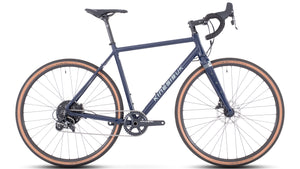
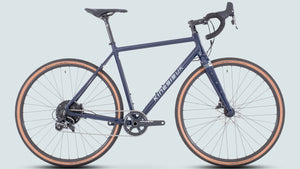
I’ve started a new job in a bike shop, learned far more about bikes, and recently got my Kinesis G2 back. Huge thanks to the team at Upgrade Bikes and Kinesis for fixing it up and for continuing to support me as an ambassador.

I’ve also signed up for Lost Dot 101 — a 1,200km self-supported route across Spain and Portugal — and I’m training again with a renewed focus on strength, conditioning and resilience. It feels good to have a goal, structure and momentum.

Life paused for a while last year, but it’s good to be moving again. Things don’t always go to plan. You won’t always see the dip coming. But keep going, take the opportunities when they arise, enjoy the good moments — and keep cycling.

From 1 to 101
A race for women, non-binary and trans riders

The Lost Dot 101 is a 1200 km race for women, non-binary, and trans riders. The inaugural edition will start in Santiago de Compostela, following a free-route format between a series of controls, and finishing in Southern Spain.

Find out more about Lost Dot 101

Back to top